
Table of contents
- How intelligent document processing (IDP) works
- IDP vs OCR: what is the difference?
- IDP vs RPA
- IDP for developers: the API approach
- Benefits of intelligent document processing
- IDP use cases by industry
- How to choose intelligent document processing software
- Why intelligent document processing is becoming essential
Intelligent document processing (IDP) is the use of AI — OCR, machine learning, and language models — to automatically read documents like invoices, receipts, contracts, and bank statements, then extract and structure their data for downstream systems. It removes the manual data entry that slows document-heavy teams, turning unstructured files into clean, validated, ready-to-use data.
How intelligent document processing (IDP) works
-
Capture: The system collects documents from email inboxes, shared folders, cloud storage, scanners, mobile uploads, or API calls. It accepts PDFs, images, and office documents, normalizing them for processing. Documents may be preprocessed to improve readability — correcting rotation, removing visual noise, or detecting layout zones.
-
Classification and extraction: IDP software identifies document type and required information. It can separate invoices from receipts, recognize payslips, utility bills, bank statements, and contracts in mixed batches. OCR converts pixels to text, then machine learning and language models locate and label fields like vendor details, dates, totals, balances, or account numbers.
-
Validation and review: The software checks extracted data for accuracy, verifying that totals add up, dates fall in allowed ranges, and tax rates look reasonable. Each field is returned with a confidence score. Low-confidence items are flagged for human review, and feedback improves the system over time.
-
Delivery and integration: Once validated, data flows to your technology stack via APIs, webhooks, and native integrations. Results push into ERP systems, accounting tools, loan origination platforms, HR systems, or custom applications without building custom extraction engines.
IDP vs OCR: what is the difference?
OCR and intelligent document processing are related but solve different problems.
OCR focuses on one task: turning images of text into characters. It tells you what letters or numbers appear on a page but does not understand what those values mean or how they relate to your process.
IDP wraps OCR inside a broader workflow. Two differences stand out:
- OCR extracts text, while IDP extracts business fields and entities such as totals, tax IDs, customer names, and contract clauses.
- OCR outputs raw text, while IDP software delivers structured, typed data, applies rules and confidence scores, and routes low-confidence items to humans for review.
In short, OCR reads. Intelligent document processing understands and operationalizes what it reads.
IDP vs RPA
Robotic process automation (RPA) automates repetitive actions inside software systems, such as copying data between applications or triggering workflows. However, RPA typically requires structured inputs to work reliably.
IDP solves a different problem: turning unstructured documents into structured data.
In many automation architectures, the two technologies work together. IDP extracts and validates information from documents, while RPA uses that structured data to automate downstream tasks across business applications.
IDP for developers: the API approach
For engineering teams, the fastest way to add intelligent document processing is through an API rather than a dashboard or UI-driven tool. Instead of building capture, OCR, classification, extraction, and validation yourself, you send a document to a single endpoint and get clean, structured JSON back.
A developer-first IDP API typically gives you:
- One endpoint for any document type — invoices, receipts, payslips, bank statements, and contracts — with no per-template setup.
- Structured, typed JSON with a confidence score on every field, ready to drop into your ERP, ledger, or database.
- Webhooks and async processing so high volumes never block your pipeline.
- Built-in validation of totals, tax, and dates before the data reaches your systems.
Invofox exposes exactly this: one cloud-agnostic API that turns any document into validated JSON. Browse the developer documentation and code samples to make your first call in minutes.
Benefits of intelligent document processing
Better data quality. Algorithms do not get tired or distracted. By combining OCR, computer vision, and language models with rule-based checks, IDP reduces common errors in amounts, dates, and identifiers and protects you from costly corrections.
Faster processing and better experiences. Documents that used to sit in queues for days can be processed in seconds or minutes. That speed matters in workflows such as loan decisions, insurance claims, invoice approvals, account openings, and payroll cutoffs.
Lower operating cost and happier teams. Automating repetitive data entry reduces the need for temporary staff during peak periods and frees employees to focus on exceptions, customer conversations, and analysis instead of copy-paste work.
Scalability without extra headcount. Document volumes often fluctuate during tax seasons, loan surges, or busy shipping periods. IDP platforms can process large document volumes automatically, allowing organizations to scale operations without proportionally increasing staff.
Stronger compliance and auditability. IDP platforms create a clear digital trail showing what was extracted, how it was validated, and who made changes. Combined with encryption and access controls, that traceability supports compliance in regulated sectors such as financial services and healthcare.
IDP use cases by industry
- Accounting and accounts payable: capture invoices and receipts, extract line items, taxes, and vendor details, then feed them into ERP or expense tools for automated matching and approvals.
- Financial services and mortgage: process loan packets, bank statements, payslips, and identity documents to accelerate credit decisions while keeping risk controls consistent.
- HR and payroll: pull employee details from contracts, onboarding forms, and payslips and sync them with HR and payroll systems without manual retyping.
- Logistics and supply chain: read purchase orders, packing lists, bills of lading, and customs forms so shipments move on time and inventory data stays accurate.
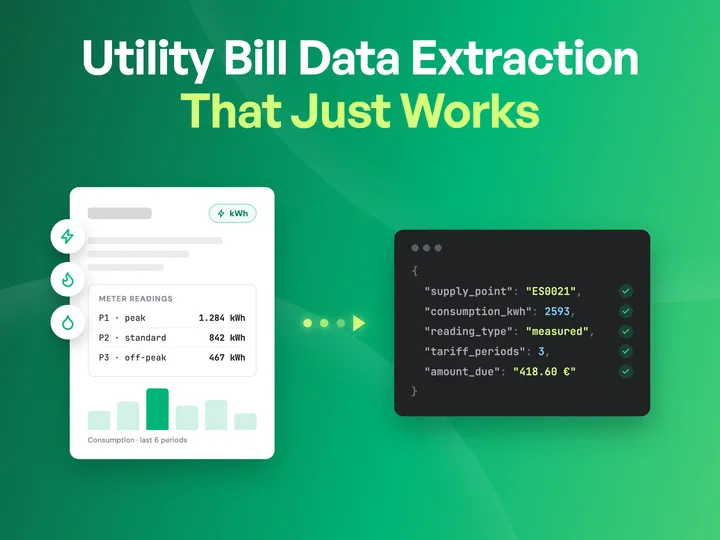
- Sustainability and utility tracking: parse utility bills from multiple providers to monitor energy and water use and support ESG and carbon reporting.
Many teams also rely on IDP for niche or custom documents. Flexible engines are designed to handle that long tail of formats without weeks of template work.
How to choose intelligent document processing software
When evaluating intelligent document processing platforms, look for:
- High accuracy across many different layouts and document sources, not only curated demos.
- Support for structured, semi-structured, and unstructured content, including tables and free text.
- Built-in validation, confidence scoring, and human-in-the-loop review flows.
- Strong developer experience with clear APIs, documentation, and webhooks.
- Security and compliance controls that match your industry requirements.
- Evidence that the vendor can handle your expected volume in production.
- The ability to process messy real-world documents, including low-quality scans, multiple languages, and changing layouts.
Intelligent document processing is becoming a standard way to turn unstructured documents into reliable, actionable data. With the right IDP software in place, you can reduce manual work, improve data quality, and move faster across document-heavy workflows while keeping control of risk and compliance.
Why intelligent document processing is becoming essential
Intelligent document processing is quickly becoming a standard way for organizations to transform unstructured documents into reliable, actionable data.
By combining OCR, machine learning, and language understanding, IDP platforms automate document-heavy workflows that once required hours of manual work.
With the right IDP software in place, organizations can reduce operational costs, improve data accuracy, and move faster across finance, logistics, HR, lending, and other document-driven processes while maintaining strong compliance and control.